







Trump Derangement Syndrome: When Hatred Replaces Reason
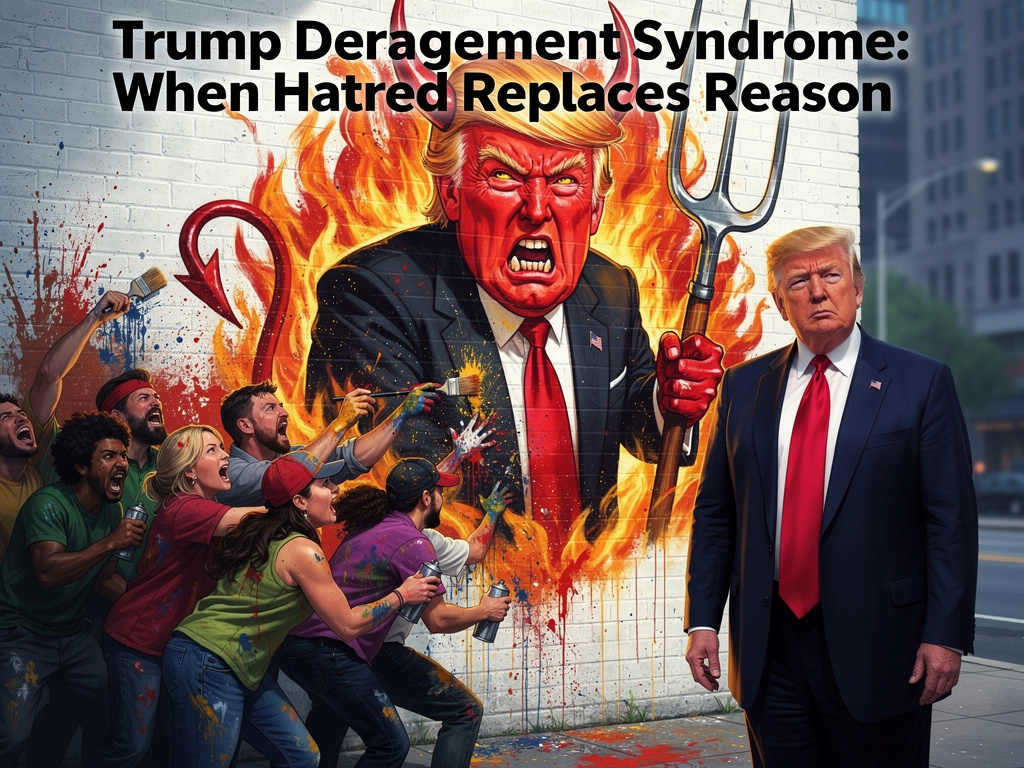
Few figures in modern American history have produced a reaction as extreme, emotional, and irrational as Donald J. Trump.
This reaction has a name—Trump Derangement Syndrome (TDS)—and while critics mock the term, the behavior it describes is real, observable, and damaging to public discourse.
TDS is not simply opposition to Trump.
Disagreement is healthy in a republic.
TDS is what happens when everything Trump does is automatically assumed to be evil, regardless of facts, intent, or outcome—and when reason is replaced by rage.
What Trump Derangement Syndrome Looks Like
TDS follows a predictable pattern:
- Trump does or says something
- Media and political opponents assume malicious intent
- Words are taken out of context or distorted
- Motives are invented
- Outrage is amplified
- Corrections are ignored
Facts become irrelevant. Narrative becomes everything.
Under TDS, Trump can’t be wrong—he must be evil. And if reality contradicts that assumption, reality is rejected.
The Inversion of Standards
One of the clearest signs of TDS is the double standard.
Actions that were praised under previous presidents are condemned under Trump. Policies supported when proposed by Democrats become “authoritarian” when implemented by Trump.
Examples include:
- Border enforcement
- Energy independence
- Trade protection
- Judicial appointments
- Questioning media narratives
The issue is not the policy.
It’s the person.
This is not political disagreement—it is identity-based hostility.
Media Manipulation and Narrative Engineering
Legacy media has played a central role in fueling TDS.
Headlines are crafted to provoke fear.
Quotes are selectively edited.
Context is routinely omitted.
Anonymous sources replace verifiable evidence.
When claims are later debunked, the corrections receive a fraction of the attention of the original accusation.
The result is not an informed public—but an emotionally primed one.
The Psychological Component
Trump Derangement Syndrome is not about Trump alone.
It exposes deeper issues:
- Loss of trust in institutions
- Tribal political identity
- Moral superiority signaling
- Inability to tolerate ideological disruption
Trump did not fit the expected mold.
He disrupted norms.
He challenged elites.
He spoke plainly—and sometimes crudely.
For many on the left, this was intolerable—not because of policy, but because of what he represented: rejection of establishment control.
When Opposition Becomes Obsession
Healthy opposition critiques ideas.
TDS obsesses over personality.
Under TDS:
- Every word is dissected for hidden meaning
- Jokes are treated as threats
- Policy disagreements become moral absolutes
- Supporters are demonized, not debated
This is why Trump voters are not merely wrong in the eyes of TDS sufferers—they are labeled racist, ignorant, or dangerous.
Dehumanization replaces dialogue.
The Cost to Democracy
Trump Derangement Syndrome doesn’t hurt Trump.
It hurts the country.
It:
- Destroys civil discourse
- Justifies censorship
- Excuses authoritarian behavior “to stop Trump”
- Normalizes political persecution
- Undermines trust in elections, courts, and media
When hatred becomes the organizing principle, democracy becomes collateral damage.
You Don’t Have to Like Trump to See the Problem
This is important:
You can dislike Trump’s personality.
You can oppose his policies.
You can vote against him.
And still recognize that Trump Derangement Syndrome is real.
When reason disappears, everyone loses—regardless of party.
Final Thought
Trump Derangement Syndrome is not about defending a man.
It’s about defending reality, standards, and sanity.
A nation cannot survive if half the country is conditioned to believe that one individual is the source of all evil—and that anything done to stop him is justified.
That is not progress.
That is mass political delusion.