




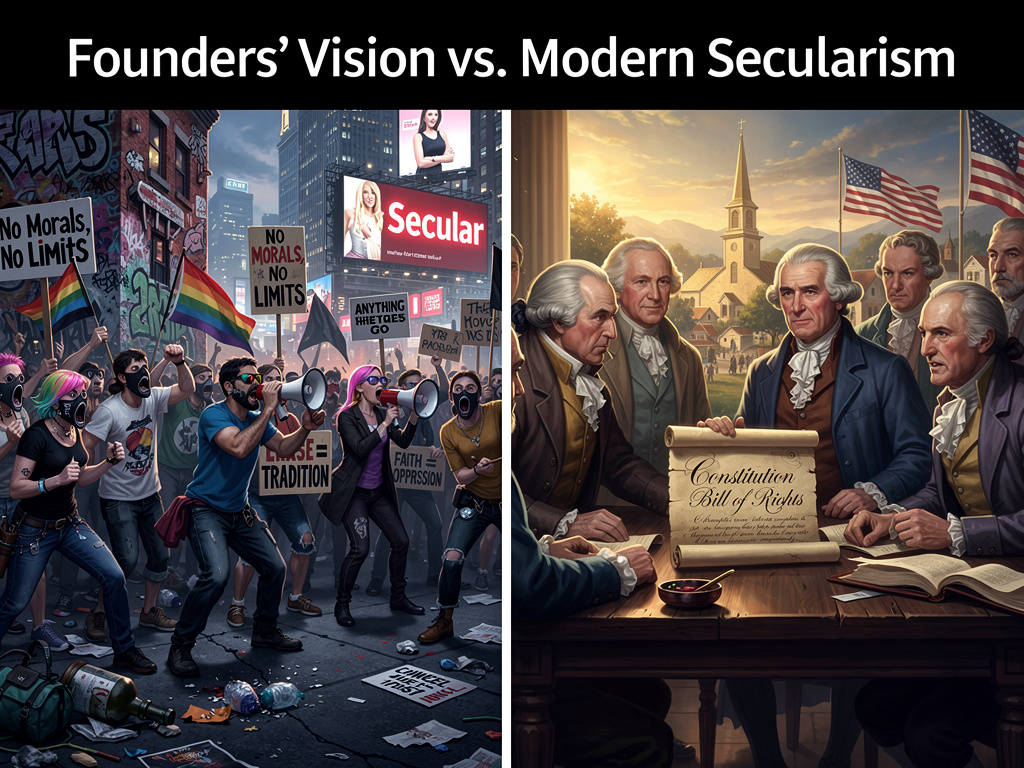


America’s Founders vs. Modern Secularism
Two Competing Moral Frameworks
America is not divided primarily by party.
It is divided by worldview.
The Founders built a republic assuming transcendent truth, moral restraint, and human fallibility.
Modern secularism rejects those assumptions—and the consequences are now unavoidable.
1. Source of Rights
Founders’ View
Rights come from God, not government.
“All men are created equal, that they are endowed by their Creator with certain unalienable Rights.”
—Declaration of Independence (1776)
Government exists to protect rights it did not create.
“The sacred rights of mankind are not to be rummaged for, among old parchments or musty records. They are written… by the hand of divinity.”
—Alexander Hamilton
Modern Secular View
Rights are granted by:
- Courts
- Legislatures
- Cultural consensus
What government grants, government can redefine or remove.
Result: Rights become conditional privileges.
2. View of Human Nature
Founders’ View
Human beings are flawed and prone to abuse power.
“If men were angels, no government would be necessary.”
—James Madison, Federalist No. 51
This belief—deeply biblical—led to:
- Checks and balances
- Separation of powers
- Limited authority
Modern Secular View
Humans are basically good.
Systems—not sin—are the problem.
Result: Power concentrates in institutions believed to be morally superior.
3. Purpose of Government
Founders’ View
Government is limited and defensive—not moralistic or utopian.
“Government is instituted for the common good; for the protection, safety, prosperity, and happiness of the people.”
—Massachusetts Constitution (1780)
Moral formation belongs primarily to:
- Families
- Churches
- Local communities
Modern Secular View
Government becomes:
- Moral instructor
- Social engineer
- Arbiter of truth
Result: Dependency replaces responsibility.
4. Role of Religion in Public Life
Founders’ View
Religious liberty protects faith from the state—not the state from faith.
“Of all the dispositions and habits which lead to political prosperity, religion and morality are indispensable supports.”
—George Washington, Farewell Address
Religion was expected to shape public virtue, not retreat from public life.
“Religion and morality alone can establish the principles upon which freedom can securely stand.”
—John Adams
Modern Secular View
Religion is:
- Private
- Subjective
- Unwelcome in public discourse
Result: Secularism becomes the dominant, enforced worldview.
5. Moral Law
Founders’ View
Law reflects a higher moral order.
“The law of nature and of nature’s God”
—Declaration of Independence
Justice was not invented by man—it was discovered.
“There exists in the mind of man a natural sense of justice.”
—Thomas Jefferson
Modern Secular View
Morality is:
- Relative
- Evolving
- Socially constructed
Result: Law becomes ideological rather than just.
6. Liberty vs. License
Founders’ View
Liberty requires self-restraint.
“Only a virtuous people are capable of freedom.”
—Benjamin Franklin
Freedom was never defined as the absence of limits.
“Liberty cannot be established without morality.”
—Alexis de Tocqueville (observing America)
Modern Secular View
Freedom means:
- Autonomy
- Self-definition
- Absence of restraint
Result: Chaos rebranded as liberation.
7. Family and Social Order
Founders’ View
Family precedes government.
“The foundation of national morality must be laid in private families.”
—John Adams
Education, discipline, and moral instruction belonged to parents—not the state.
Modern Secular View
Family is:
- Redefinable
- Secondary to state authority
- Subject to government oversight
Result: Social fragmentation and generational instability.
8. Accountability and Power
Founders’ View
Leaders are accountable—to law, the people, and God.
“Power must never be trusted without a check.”
—John Adams
Public office was stewardship, not entitlement.
Modern Secular View
Accountability is:
- Political
- Narrative-driven
- Outcome-justified
Result: Power without repentance.
The Irreconcilable Difference
The Founders assumed:
- Truth is objective
- God judges nations
- Virtue sustains freedom
Modern secularism assumes:
- Truth is negotiable
- History replaces God
- Power replaces virtue
These systems cannot coexist indefinitely.
Final Word
America’s crisis is not merely political.
It is moral and theological.
The Founders understood something modern secularism denies:
“Our Constitution was made only for a moral and religious people. It is wholly inadequate to the government of any other.”
—John Adams
When the moral foundation erodes, the structure will follow.
This is not nostalgia.
It is historical reality.