





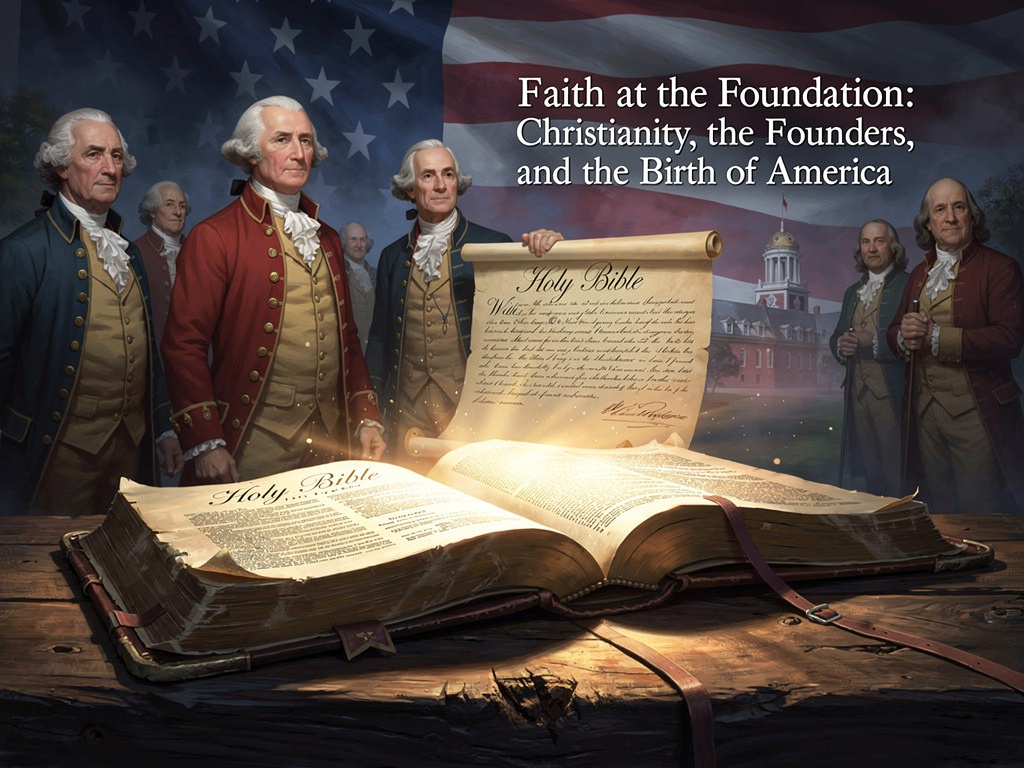

Faith at the Foundation: Christianity, the Founders, and the Birth of America
America did not emerge from a religious vacuum.¹
Nor was it founded as a secular experiment divorced from Christian ethics.²
The United States was forged by men deeply shaped by biblical morality, Christian worldview assumptions, and centuries of Protestant political thought—even when they disagreed theologically or personally failed to live up to those ideals.³
George Washington: Public Faith and Moral Conviction
George Washington was not a theologian.
He was a statesman shaped by Christian ethics.
In his Farewell Address, Washington warned:
“Of all the dispositions and habits which lead to political prosperity, religion and morality are indispensable supports.”⁴
Washington regularly referenced Providence, viewed the American victory as divinely aided, and believed religion was essential to public virtue. In a letter to the clergy, he wrote:
“The pure and benign light of Revelation has had a meliorating influence on mankind.”⁵
Washington’s faith was restrained and dignified, but unmistakably rooted in Christian moral assumptions.
Thomas Jefferson: Christian Ethics Without Orthodoxy
Thomas Jefferson rejected orthodox doctrines such as the Trinity and miracles.⁶
Yet he consistently praised Jesus’ moral teachings, writing:
“The moral doctrines of Jesus… are the most benevolent and sublime probably that has ever been taught.”⁷
Jefferson’s famous “wall of separation” letter (1802) was written to protect churches from state interference—not to exclude Christian influence from public life.⁸
Importantly, Jefferson grounded rights in a Creator, not the state:
“All men are created equal… endowed by their Creator with certain unalienable Rights.”⁹
That claim is theological by definition.
John Adams: Liberty Requires Virtue
John Adams was explicit about Christianity’s role in sustaining the republic:
“Our Constitution was made only for a moral and religious people. It is wholly inadequate to the government of any other.”¹⁰
Adams believed law alone could not restrain vice—only virtue could—and that Christianity historically produced the moral framework necessary for liberty.¹¹
James Madison: Biblical Realism About Human Nature
James Madison’s political philosophy assumed human fallibility, not Enlightenment optimism.
This assumption—central to checks and balances—aligns closely with the biblical view of human sinfulness.¹² Madison wrote:
“If men were angels, no government would be necessary.”¹³
The Constitution’s structure reflects a Christian-informed skepticism of unchecked power.
The Declaration of Independence: A Moral and Theological Appeal
The Declaration of Independence appeals repeatedly to divine authority, referencing:
- “The Laws of Nature and of Nature’s God”
- A Creator who grants rights
- “The Supreme Judge of the world”
- “Divine Providence”¹⁴
These are not secular claims.
They assume objective moral law grounded in God.
George Whitefield and the Great Awakening
Before political independence came spiritual renewal.
George Whitefield’s preaching during the First Great Awakening (1730s–1740s):
- United colonies through shared moral language
- Challenged authoritarianism
- Emphasized personal accountability to God over institutions¹⁵
Historian Mark Noll notes that the Great Awakening helped lay the cultural groundwork for resistance to tyranny.¹⁶
Christianity Did Not Create a Theocracy—It Created a Framework
The founders did not establish a state church.¹⁷
They assumed a moral people shaped by Christian teaching.
Remove that assumption, and—as Adams warned—the system fails.
Final Word
America was not founded as a church.
But it was founded on Christian moral assumptions, biblical views of human nature, and belief in divine accountability.
As historian Alexis de Tocqueville later observed:
“Religion… must be regarded as the first of their political institutions.”¹⁸
Liberty did not create virtue.
Virtue made liberty possible.
Footnotes
- Mark A. Noll, America’s God
- Daniel L. Dreisbach, Religion and Politics in the Early Republic
- John Witte Jr., Religion and the American Constitutional Experiment
- George Washington, Farewell Address (1796)
- Washington, Letter to the General Committee of the United Baptist Churches (1789)
- Jefferson, Autobiography
- Thomas Jefferson, Letter to William Short (1820)
- Jefferson, Letter to Danbury Baptist Association (1802)
- Declaration of Independence (1776)
- John Adams, Letter to the Officers of the First Brigade of the Third Division of the Militia of Massachusetts (1798)
- Adams, A Defence of the Constitutions of Government of the United States
- Romans 3:23 (conceptual influence acknowledged by multiple historians)
- James Madison, Federalist No. 51
- Declaration of Independence (1776)
- Thomas S. Kidd, George Whitefield: America’s Spiritual Founding Father
- Mark Noll, The Old Religion in a New World
- First Amendment, U.S. Constitution
- Alexis de Tocqueville, Democracy in America