







This blog post contrasts Bible-confirmed history with Qur’anic historical and narrative problems, while clearly framing claims as textual and historical critiques.
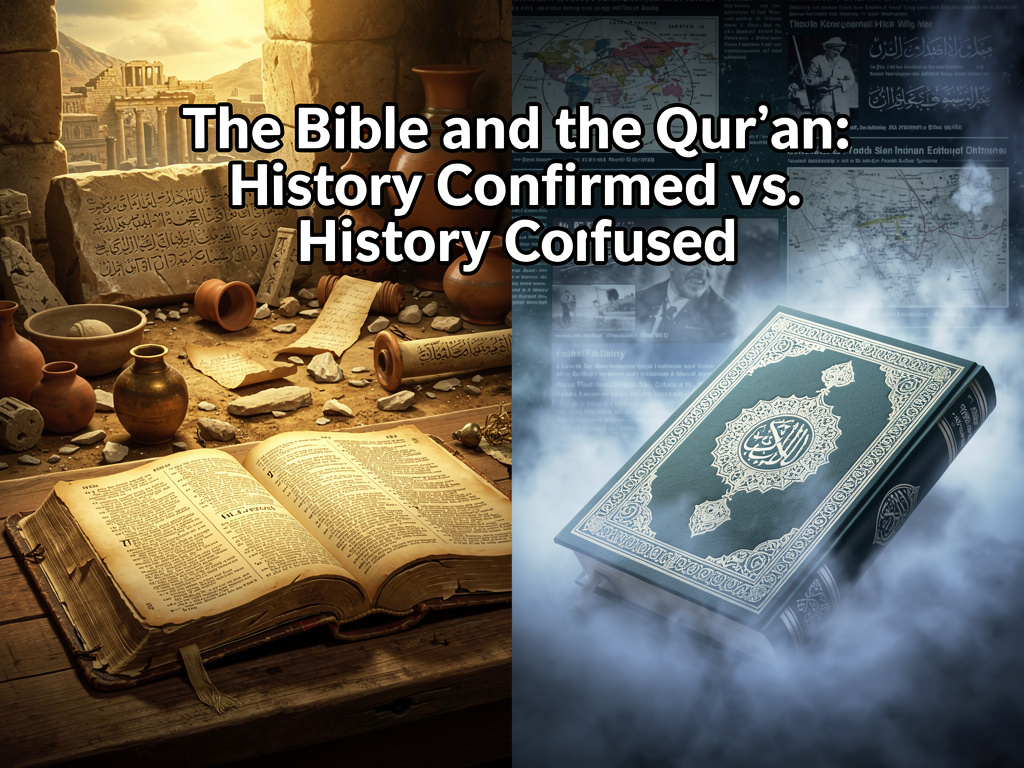
The Bible and the Qur’an: History Confirmed vs. History Confused
Sacred texts do not exist in a vacuum.
They make claims about real people, real places, and real events. Those claims can be tested against archaeology, historical records, geography, and internal consistency. When we do that, a sharp contrast emerges between the Bible and the Qur’an.
This is not a comparison of faith experiences.
It is a comparison of historical reliability.
The Bible: Rooted in Verifiable History
For centuries, critics claimed the Bible was mythological—until archaeology began catching up.
Historically Verified People and Places in the Bible
- Pontius Pilate
Once doubted, now confirmed by the Pilate Stone discovered in Caesarea (1961). - The Hittites
Long dismissed as fictional until their civilization was uncovered in modern-day Turkey. - The Pool of Bethesda (John 5)
Excavated with the exact five-portico structure described in Scripture. - The House of David
Confirmed by the Tel Dan Stele, a 9th-century BC inscription referencing the “House of David.” - Nazareth, Capernaum, Jericho, Jerusalem
All archaeologically confirmed and continuously inhabited locations.
The Bible names specific kings, cities, empires, and chronological markers, inviting verification rather than avoiding it.
Luke opens his Gospel by stating his intent plainly:
“I myself have carefully investigated everything from the beginning…”
— Luke 1:3
This is historical methodology—not mystical dictation.
The Qur’an: Narrative Borrowing and Historical Problems
By contrast, the Qur’an—written roughly 600 years after the Bible—often retells biblical stories with altered details, confused identities, and historical anachronisms.
Confusion of Biblical Characters
Saul, Gideon, and Talut (Qur’an 2:247)
The Qur’an introduces a king named Talut, often identified in Islamic tradition as Saul. However, the narrative surrounding Talut closely mirrors Gideon’s story from Judges 6–7:
- Testing soldiers at a river
- Selecting a small fighting force
- Divine approval through reduction
In the Bible:
- Saul is chosen by lot, disobeys God, and loses the kingdom
- Gideon tests troops by how they drink water and defeats enemies with a small army
The Qur’an blends these narratives into a single figure, producing a composite character unknown to the Bible or Jewish tradition.
Mary Confused with Miriam
In Qur’an 19:28, Mary (the mother of Jesus) is called:
“Sister of Aaron”
Aaron was the brother of Moses, living over 1,400 years before Mary.
While Islamic apologists argue this is an honorific title, the phrasing mirrors the biblical Miriam, Moses’ sister—suggesting a genealogical confusion, not a metaphor.
Haman Placed in the Wrong Empire
The Qur’an repeatedly places Haman as a high official under Pharaoh in Egypt (Qur’an 28:6, 38).
In the Bible, Haman is a Persian official serving under King Xerxes (Esther 3), over 1,000 years later and in a completely different empire.
No Egyptian records place a figure named Haman in Pharaoh’s court.
The Samaritan Anachronism
In Qur’an 20:85–95, a character called “the Samaritan” leads Israel astray with the golden calf.
Problem:
- Samaritans did not exist until centuries after Moses
- They emerged following the Assyrian exile (8th century BC)
This places a later group into an earlier historical setting—an anachronism.
Dhul-Qarnayn and Legendary Geography
The Qur’an describes a ruler called Dhul-Qarnayn who:
- Travels to where the sun sets in a muddy spring (Qur’an 18:86)
- Builds a massive iron wall to hold back Gog and Magog
Many Islamic scholars historically identified Dhul-Qarnayn as Alexander the Great, whose legends were widespread in Syriac folklore—but whose actions and cosmology are mythical, not historical.
Method Matters
The Bible:
- Names rulers who can be verified
- Anchors events to real locations
- Preserves distinct individuals and timelines
- Invites scrutiny
The Qur’an:
- Retells biblical stories without sources
- Combines or confuses characters
- Introduces historical anachronisms
- Avoids precise chronology
This difference is not accidental.
Christianity emerged inside history.
Islam re-narrated history from a distance.
Why This Matters
If a text claims divine origin, accuracy matters.
The God of the Bible acts in time, space, and history—and leaves evidence behind. The Qur’an often reflects oral traditions, later legends, and theological reshaping, not eyewitness preservation.
This does not mean Muslims are dishonest.
It means their book reflects a different origin and method.
Truth welcomes testing.
Myth resists it.
Final Thought:
A faith grounded in history does not fear archaeology. A faith grounded in legend must reinterpret it.