






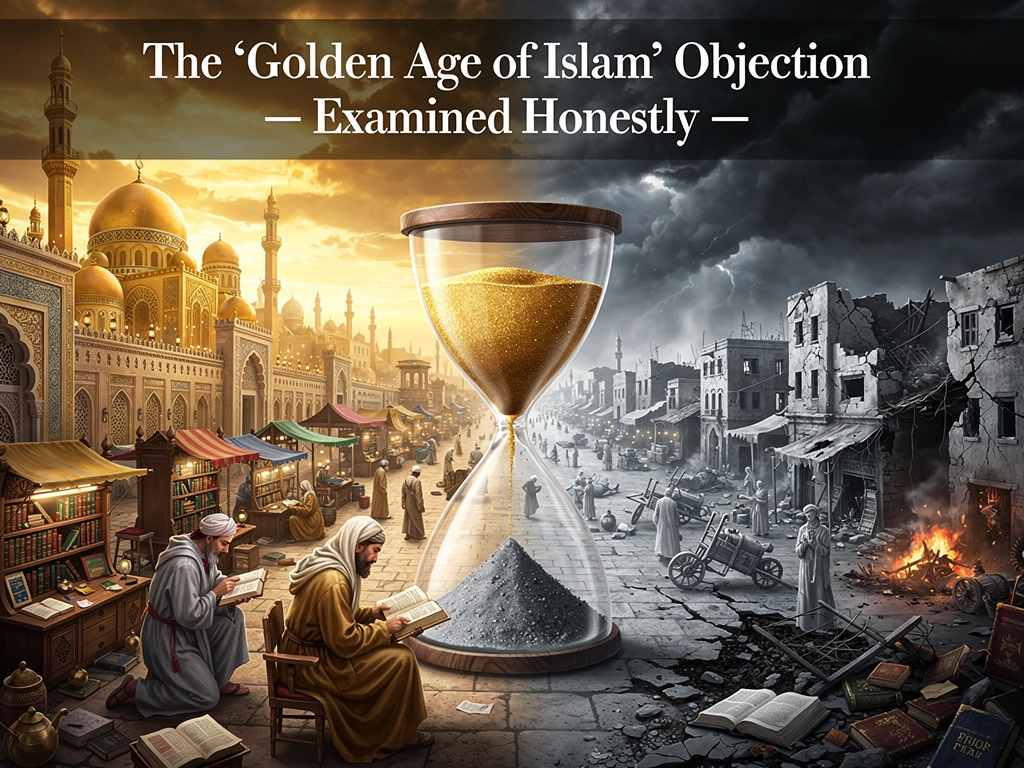

The “Golden Age of Islam” Objection — Examined Honestly
Whenever the historical outcomes of Christianity and Islam are compared, a predictable objection arises:
“What about the Golden Age of Islam?”
It’s presented as a conversation-ender—a proof that Islam fosters learning, tolerance, and flourishing civilizations. But when examined carefully, the claim does not hold up in the way it’s commonly used.
The issue is not whether achievements occurred.
The issue is why they occurred, how long they lasted, and what ended them.
What People Mean by the “Golden Age of Islam”
The term typically refers to a period roughly between the 8th and 11th centuries, centered mainly in:
- Baghdad (Abbasid Caliphate)
- Parts of Persia
- Muslim-ruled Spain (Al-Andalus)
During this time, the Islamic world preserved and expanded upon:
- Greek philosophy
- Roman medicine
- Persian administration
- Indian mathematics
These are real historical developments. But context matters.
1. The “Golden Age” Was Built on Borrowing, Not Revelation
Nearly all major intellectual advances during this period came from non-Islamic sources:
- Aristotle, Plato, Hippocrates, Galen — Greek
- Mathematics — Indian
- Astronomy and administration — Persian
Muslim scholars translated and preserved this material, often employing:
- Christians
- Jews
- Zoroastrians
This raises an important question:
If Islamic revelation itself produces flourishing science and philosophy, why did innovation decline once these external sources were exhausted?
Preservation is valuable—but preservation is not origination.
2. The “Golden Age” Thrived In Spite of, Not Because of, Islamic Theology
Theological Islam has always been uneasy with:
- Philosophical inquiry
- Independent reasoning (ijtihad)
- Scientific speculation that challenges revelation
This tension came to a head with figures like Al-Ghazali, whose work The Incoherence of the Philosophers argued that philosophy undermines faith.
The result?
- Philosophy was delegitimized
- Free inquiry collapsed
- Scientific advancement slowed dramatically
In Christian Europe, by contrast:
- Theology and reason were treated as compatible
- Universities institutionalized debate
- Inquiry expanded instead of contracted
One system absorbed reason.
The other suppressed it.
3. Tolerance Was Conditional, Not Equal
Muslim rulers often allowed Christians and Jews to live under Islamic rule—but only as dhimmis:
- Second-class legal status
- Special taxes (jizya)
- Restricted public worship
- Prohibition on evangelism
- Social and legal inferiority
This was not pluralism.
It was managed subjugation.
By contrast, Christian nations—over time—developed:
- Equal citizenship
- Freedom of conscience
- Legal protections for dissenters
Again, not perfectly—but progressively.
4. The “Golden Age” Was Short and Never Recovered
This is the most overlooked fact.
The Islamic world never had a second Golden Age.
Once decline set in:
- Scientific leadership vanished
- Institutions stagnated
- Reform movements were resisted
- Innovation shifted elsewhere—permanently
Christian civilization, however:
- Experienced repeated renewals
- Corrected internal failures
- Produced the Renaissance, Reformation, Enlightenment, and Industrial Revolution
A civilization grounded in Christianity self-corrected.
Islamic civilization froze.
5. Spain (Al-Andalus) Is Often Romanticized
Muslim Spain is frequently held up as proof of Islamic tolerance and progress.
But historically:
- Christians and Jews lived under dhimmi law
- Periods of tolerance alternated with persecution
- Intellectual life declined long before Christian reconquest
- Once Islamic rule ended, Europe—not the Islamic world—entered modernity
If Islam inherently produced flourishing societies, Spain would have remained dominant after centuries of Islamic governance.
It did not.
The Core Question the Objection Avoids
The real question is not:
“Did good things ever happen under Islamic rule?”
The real question is:
“Why did they stop—and why did they never resume?”
Ideas that produce lasting civilizations do not burn brightly and then vanish.
They compound over time.
Christian principles did.
Islamic political theology did not.
Why This Matters Today
Modern Muslim-majority nations:
- Struggle with freedom of speech
- Suppress religious dissent
- Lag in scientific output
- Experience chronic instability
This is not because of colonialism alone.
It is not because of resources.
It is because religious foundations shape institutions.
The “Golden Age” objection doesn’t refute this.
It actually confirms it.
Final Thought:
A civilization’s true test is not whether it shines briefly, but whether it can renew itself.
Christianity has done that—again and again.
Islam has not.
That is not prejudice.
That is history.