






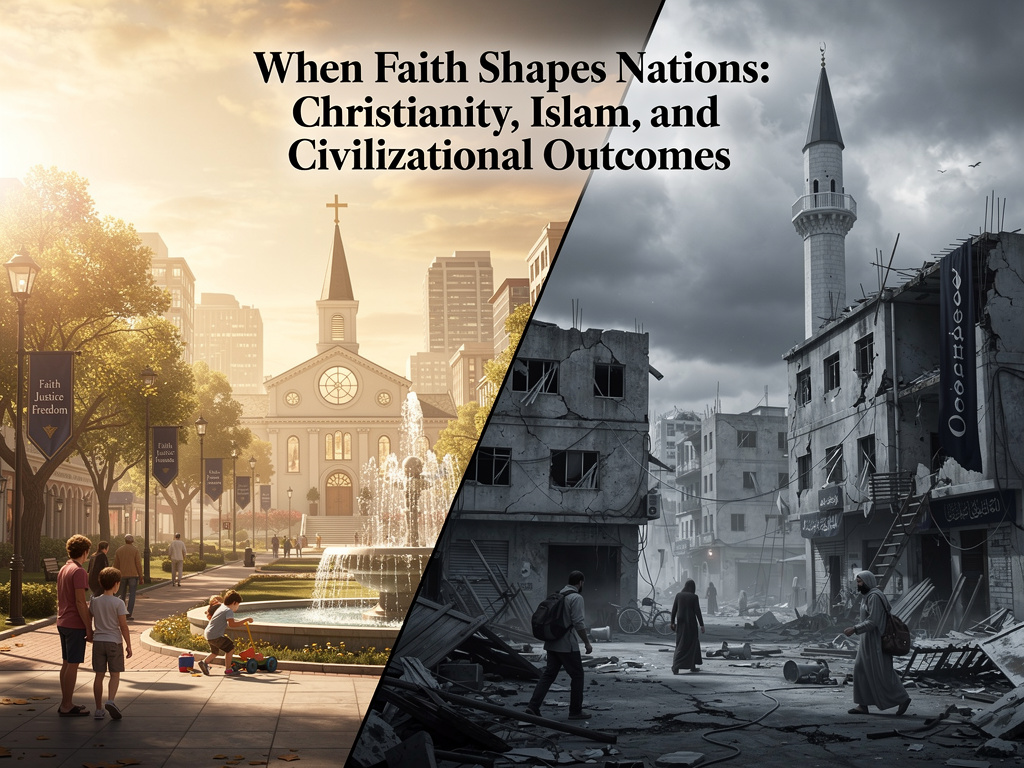

When Faith Shapes Nations: Christianity, Islam, and Civilizational Outcomes
Every civilization is built on first principles.
What a society believes about God, law, the individual, women, knowledge, and power will inevitably shape how that society governs, builds, and endures. Christianity and Islam are not merely private faiths—they are totalizing worldviews. When each has shaped nations, the results have been markedly different.
This is not about race, geography, or ethnicity.
It is about religious foundations.
Christianity’s Civilizational Principles
Historic Christianity introduced several ideas that transformed societies:
- Law above rulers (even kings answer to God)
- Human dignity rooted in the image of God
- Moral limits on power
- The separation of church authority and state authority
- The encouragement of education, inquiry, and conscience
These principles laid the groundwork for:
- Rule of law
- Universities
- Hospitals
- Scientific inquiry
- Economic innovation
- Representative government
Christianity did not create perfect nations—but it created self-correcting ones.
Islam’s Civilizational Principles
Classical Islam operates on different foundations:
- Religious law (Sharia) above civil law
- No separation of mosque and state
- Political authority fused with religious authority
- Fixed legal categories for believers and non-believers
- Limited freedom of conscience and speech
Islam can produce order—but it struggles to produce pluralism, innovation, and long-term institutional reform without abandoning its own legal structure.
Case Studies: Flourishing Before Islam, Decline After
Egypt: From Christian Intellectual Center to Controlled State
Before Islamic conquest (pre-7th century):
- Egypt was overwhelmingly Christian (Coptic)
- Alexandria was one of the greatest intellectual centers in the world
- Advances in medicine, theology, philosophy, and education
- Integrated into the Roman and Byzantine economic system
After Islamic conquest (7th century onward):
- Gradual Islamization through taxation (jizya), legal pressure, and social restriction
- Christian population diminished from majority to minority
- Intellectual output centralized under religious control
- Modern Egypt remains economically stagnant, politically authoritarian, and religiously constrained
Egypt did not collapse overnight—but it never recovered its pre-Islamic cultural and intellectual prominence.
North Africa: From Roman-Christian Prosperity to Fragmentation
Before Islam (modern Tunisia, Algeria, Libya):
- Fully integrated Roman provinces
- Predominantly Christian
- Advanced agriculture, trade networks, roads, and cities
- Produced figures like Augustine of Hippo
After Islamic conquest:
- Urban centers declined
- Christian communities slowly disappeared
- Region fractured into caliphates, dynasties, and tribal rule
- Eventually became economically peripheral to Europe
North Africa went from a civilizational contributor to a civilizational consumer.
Syria: From Christian Heartland to Perpetual Conflict
Before Islam:
- One of the most Christianized regions on earth
- Major centers of theology, trade, and governance
- Diverse but stable under Christian-influenced Roman law
After Islamic rule:
- Christians reduced to dhimmi status
- Periodic persecution and heavy taxation
- Modern Syria marked by authoritarianism, sectarianism, and violence
The region never regained the stability or pluralism it once had.
Contrast: Europe Under Christianity
While the Middle East and North Africa declined under Islamic dominance, Christian Europe—often dismissed as “backward”—did the opposite:
- Built universities (Paris, Oxford, Bologna)
- Developed modern science
- Created constitutional governance
- Abolished slavery internally
- Produced the Industrial Revolution
- Generated unprecedented prosperity
Europe’s success was not despite Christianity—but because Christianity placed moral limits on power and elevated the individual.
The Pattern Is Global
Where Islam dominates politically today:
- Limited religious freedom
- Weak civil institutions
- Authoritarian governance
- Economic underperformance
- Mass emigration
Where Christianity historically shaped law and culture:
- Strong institutions
- Innovation
- Human rights frameworks
- Stable governance
- Economic growth
This does not mean Christian nations are sinless.
It means they are structurally capable of reform.
Islamic systems, by contrast, treat reform as apostasy.
Why This Matters Now
This is not a call to dominate.
It is a call to understand consequences.
Ideas don’t stay in books.
They build—or break—nations.
If America abandons its Christian moral framework, it will not become neutral.
It will become something else.
History is not silent on what that something else looks like.
Final Thought:
Civilizations rise or fall based on what they worship—and what limits they place on power.